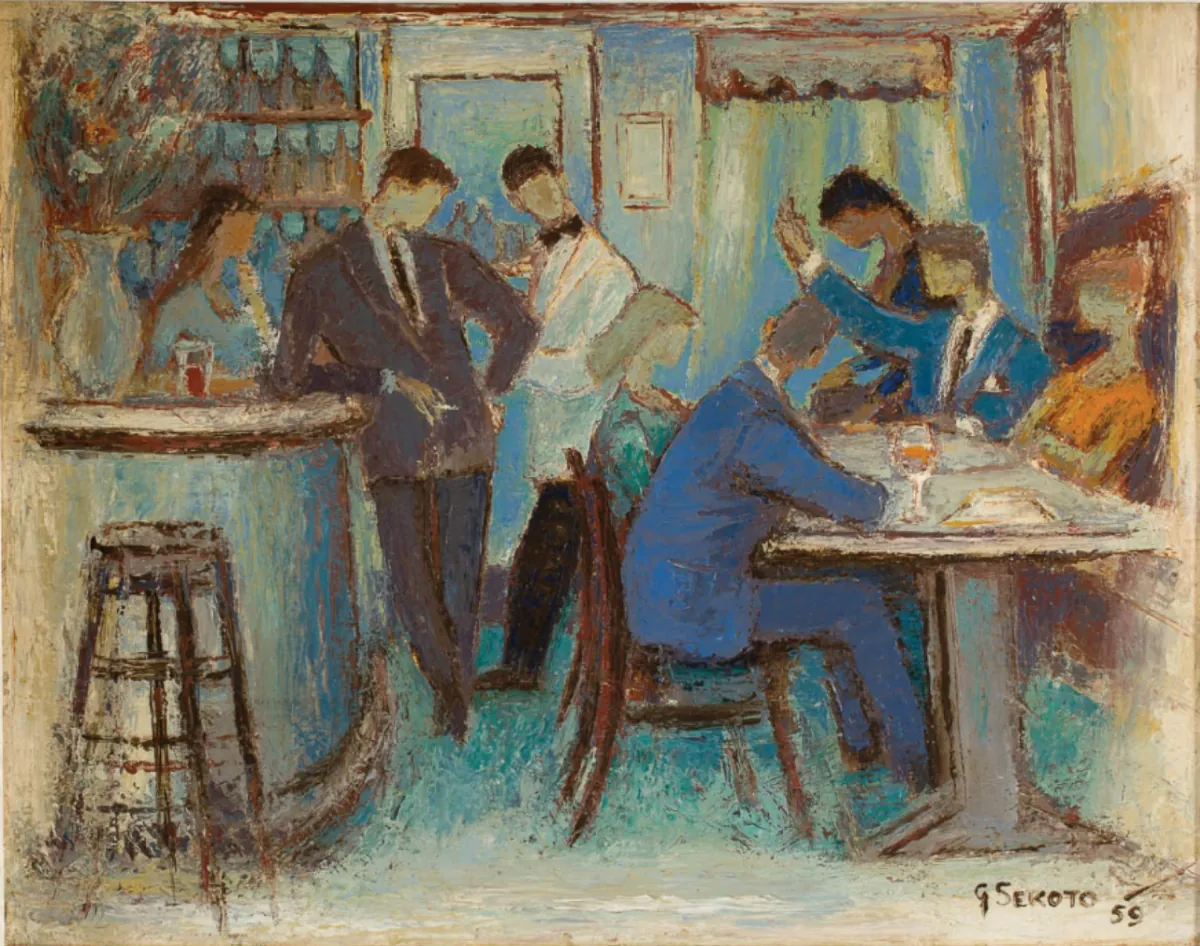
Le Café Parisien
by Gerard Sekoto, 1959
Tendai Shamu's reflection on how Sekoto’s Le Café Parisien shattered his inherited Western bias and captured the quiet freedom he now seek in Paris
I fell in love with this painting because it exposed a bias I did not want to admit I carried.
For a long time, my aesthetic confidence came with a hidden hierarchy. Western education gave me taste and language, then quietly suggested where “serious” brilliance lives. Growing up in post-Rhodesian and post-apartheid surroundings should have made me immune. It did not. I could name the history, yet still treat the West as the default reference point. African art was allowed to be political, contextual, important. It was rarely allowed to be simply magnificent.
My unlearning has been slow and humbling. Russian poetry broke open my emotional range. Chinese philosophy challenged my obsession with control and certainty. African art did something sharper. It showed me how often my early judgement was not judgement at all, just inherited settings.
Sekoto sits right at that fault line.
Gérard Sekoto arrived in Paris in 1947 looking for a life not constrained by apartheid. Paris was not just escape. It was permission. Permission to be an artist without the constant pressure of being reduced, explained, managed. By 1959, he paints Le Café Parisien and makes the ordinary feel like a moral stance.
This is not postcard Paris. It is not glamour or romance. It is a room, tables, bodies, silence, conversation. People together, people alone. A public space that still lets you keep your interior life intact. Sekoto captures the café as a small civilisation: community without coercion, proximity without intrusion.
That is exactly why it hits me.
When people ask where you are from, they are often asking for a shortcut. “Tendai from London.” A label that lets them file you neatly. My truth is less tidy. Like Sekoto, I live in Paris. Not exiled, yet not fully at home in my former life either. I keep my office and my home in London, but I spend eight or nine months of the year in Paris because Paris loosens the grip. It gives me space to breathe and to rebuild.
A café, especially in Paris, is the perfect symbol for that. You can belong without being claimed. You can be present without performing. You can be seen without being interrogated. That matters when you have spent years carrying other people’s expectations, and your own.
Sekoto’s story adds another uncomfortable mirror. He was largely overlooked during his lifetime. Now he is recognised as a pioneer of Black South African modernism, one of the most influential South African painters. That arc is familiar. When the world is slow to honour certain kinds of genius, we learn to hesitate too. We learn to wait for permission to admire what should have been obvious.
This painting does not ask for permission.
It is confident, humane, and restrained. It insists that ordinary life can hold depth. It insists that belonging is not always loud. Sometimes it is a table in a café, the hum of strangers, and the quiet relief of not having to explain yourself.
That is what I am drawn to.
Not Paris as a fantasy, but Paris as a place where you can finally live in the in-between without apologising for it.