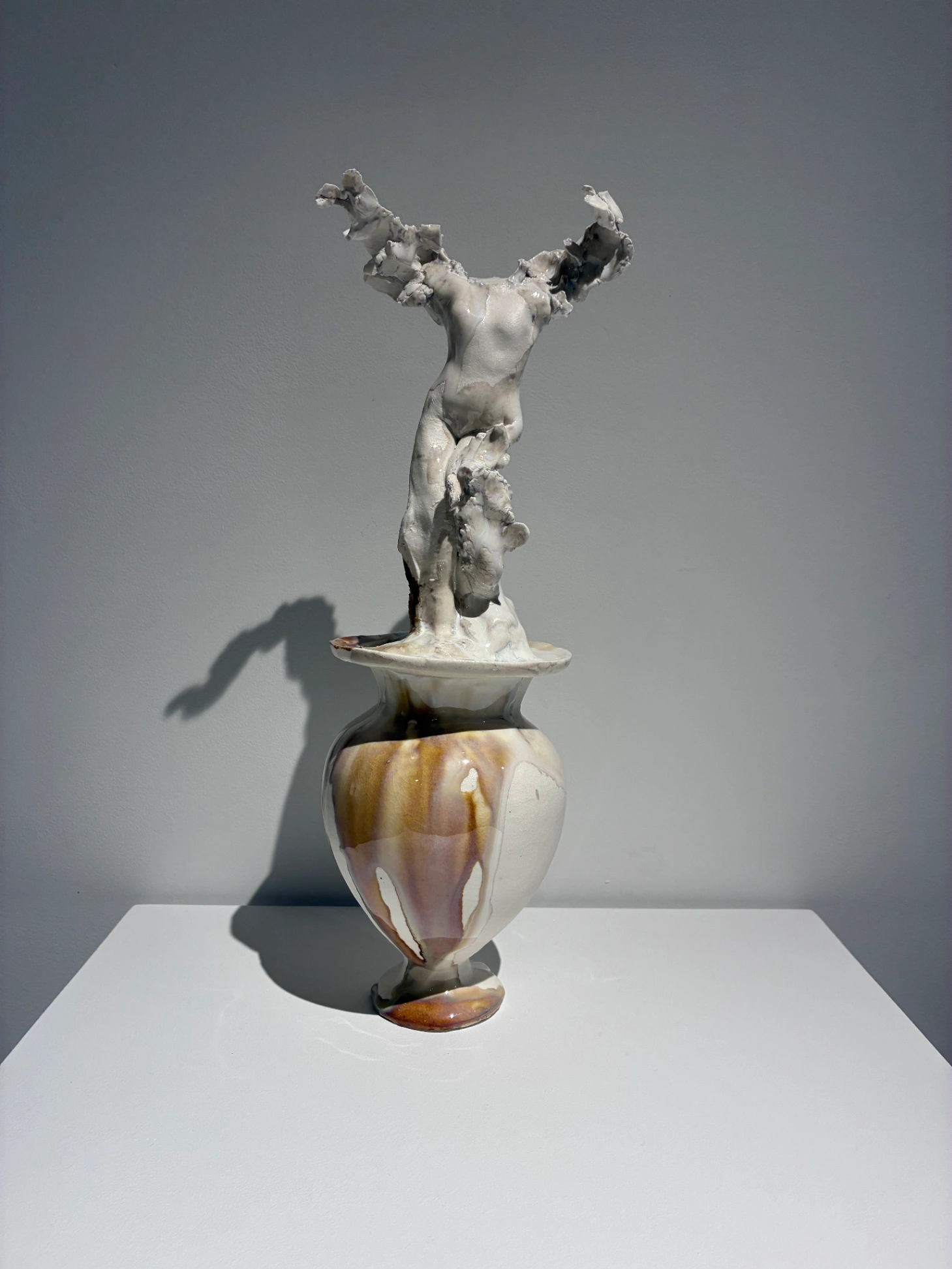
Winged Figure
by Tancredi di Carcaci, 2026
Tancredi di Carcaci, Winged Figure (2026). A porcelain sculpture combining a fragmented, winged human figure with a glazed vessel, exploring the relationship between the human body and ancient forms.
This story, like many things in my life, starts in Paris. The most magnificent sculpture I have ever seen is missing its head. The Winged Victory of Samothrace stands above that enormous staircase in the Louvre, framed by magnificent stone arches. I doubt she was placed there by accident; anywhere else would be an injustice. I suspect that someone who is not into art would be impressed.
Nike stands on a marble ship’s prow, part of a monument believed to commemorate a naval victory. More than two thousand years later, we cannot confidently identify the battle. We remember the goddess better than what anyone actually won. I wonder how much of what we pursue today will survive even two hundred years, let alone two thousand.
Ships carried those ancient ambitions across the Mediterranean. Aircraft carry mine across the Atlantic. New territories then, new markets now: I am a white-collar what-what, boarding flights because I am trying to grow wings. Since seventeen, I have spent much of (I lie, all) my life desperate to win. Desperate is the correct word. Somewhere along the way, I began compromising values instilled in me growing up. The wings kept growing, while I became less certain about the person they were carrying.
The goddess lost her head to history. I fear I have been losing mine precisely because I am growing wings. I played stupid games and won stupid prizes, while victories that actually mattered eluded me. What troubles me is whether I lost myself or was always willing to become this person. Would seventeen-year-old me have refused those compromises? Perhaps I knew what I was agreeing to each time without wanting to consider who those agreements were making me. “I lost myself” is a convenient explanation if it allows me to overlook the choices I made.
I could never own the goddess, and my London apartment would struggle even if someone robbed the Louvre. Then I woke up one day and decided to come to New York City (legit). Despite Manhattan’s helpful grid, I managed to get lost walking from NoHo towards Gramercy Park and stumbled upon Corpus, Tancredi di Carcaci’s exhibition at Palo Gallery.
His Winged Figure immediately reminded me of her. A fragmented porcelain body rises from a vessel, its wings rough and incomplete. The whole thing looks excavated rather than recently made. Nike is a complete idea represented by an incomplete body; this figure seemed to me to be acquiring wings while losing its human identity. Whatever Tancredi intended, that was the uncomfortable recognition. It was also only 44.5 by 13 centimetres. After years admiring monumental victory, here was something small enough to live with.
That scale appealed to me because I have been trying to recognise smaller victories. I have not had a drop of alcohol since mid-June, a decision I made (again) and have continued to honour. A day becomes a week, a week becomes a month. The progress comes from repeating the decision, which is less glamorous than one great triumph but considerably more useful to me. The gallery offered another opportunity to practise that sort of change. I did not take it.
New York had just enjoyed weeks of major exhibition launches. At Sean Kelly, both Sean and his daughter Lauren approached me; Lauren showed me additional works privately, and later they introduced me to Kehinde Wiley at an exclusive after-party. The Hauser & Wirth team were similarly welcoming at George Rouy’s opening, and George subsequently spent half an hour discussing his work outside Manuela in SoHo. Order the biscuits (what we call scones) … they are to die for.
These were considerably larger galleries with bigger crowds. I collect art here and there and attend exhibitions and fairs around the world; I do not expect special treatment. A hello would suffice and, as far as I am aware, has never bankrupted a gallery. At Palo, nobody acknowledged me. I wasn’t particularly interested in finding out why. I am someone who votes with his pocket, so I walked out. I have not been back.
There are probably estate agents, art dealers and fund managers who would say I failed to follow through. Invariably, money they expected from me stayed in my pocket. Perhaps I discovered an agent prioritising their commission, a dealer concealing their interests, or a fund manager who regarded me as dumb money. Sometimes it was the way someone spoke to me. I withdraw without feeling obliged to explain myself. I have a long and successful history of doing so. Or, in simple English, I have been petty and it has paid off.
In Inside Man, Dalton Russell calls respect “the ultimate currency”. I understand that. I am Black, and for me respect doubles up: dignity has not always been treated as something that black people were entitled to. That also informs my solidarity with Jewish people and my support for Israel. I do not consider contempt harmless simply because it arrives casually. Disrespect can matter more to me than money, which explains why withholding money has become such an instinctive response.
The annoying thing is that I still want the sculpture. I left without asking the price or whether it was available; for all I know, it has now been sold. Palo should have welcomed me. Yet have I made the satisfaction of withholding my money into another prize I must win, regardless of what I actually want? Respect matters to me. Whether every response I make in its name serves me is a different question.
A small victory would have been pausing to consider whether I was taking it personally, and whether withdrawing served me. I could still have walked away, or I could have asked about the sculpture. Repeating that pause might mean fewer relationships ended automatically and fewer opportunities abandoned. Like not drinking, it would take practice. Recognising the pattern does not mean I have stopped repeating it.
I won’t return because I have not yet evolved, neither am I in NYC. I will ask a mutual friend to contact the artist; my finsta suggests we have twenty-plus mutuals. That might get me the sculpture. It would not, by itself, mean I had changed.
The goddess at the Louvre will probably remain my favourite sculpture. This much smaller figure asks something more immediate of me. I still want to win, but I would like to become better at choosing my victories, including the ones nobody else would notice. I have spent a great deal of my life trying to grow wings. I think it might be time to pay a little more attention to keeping my head.