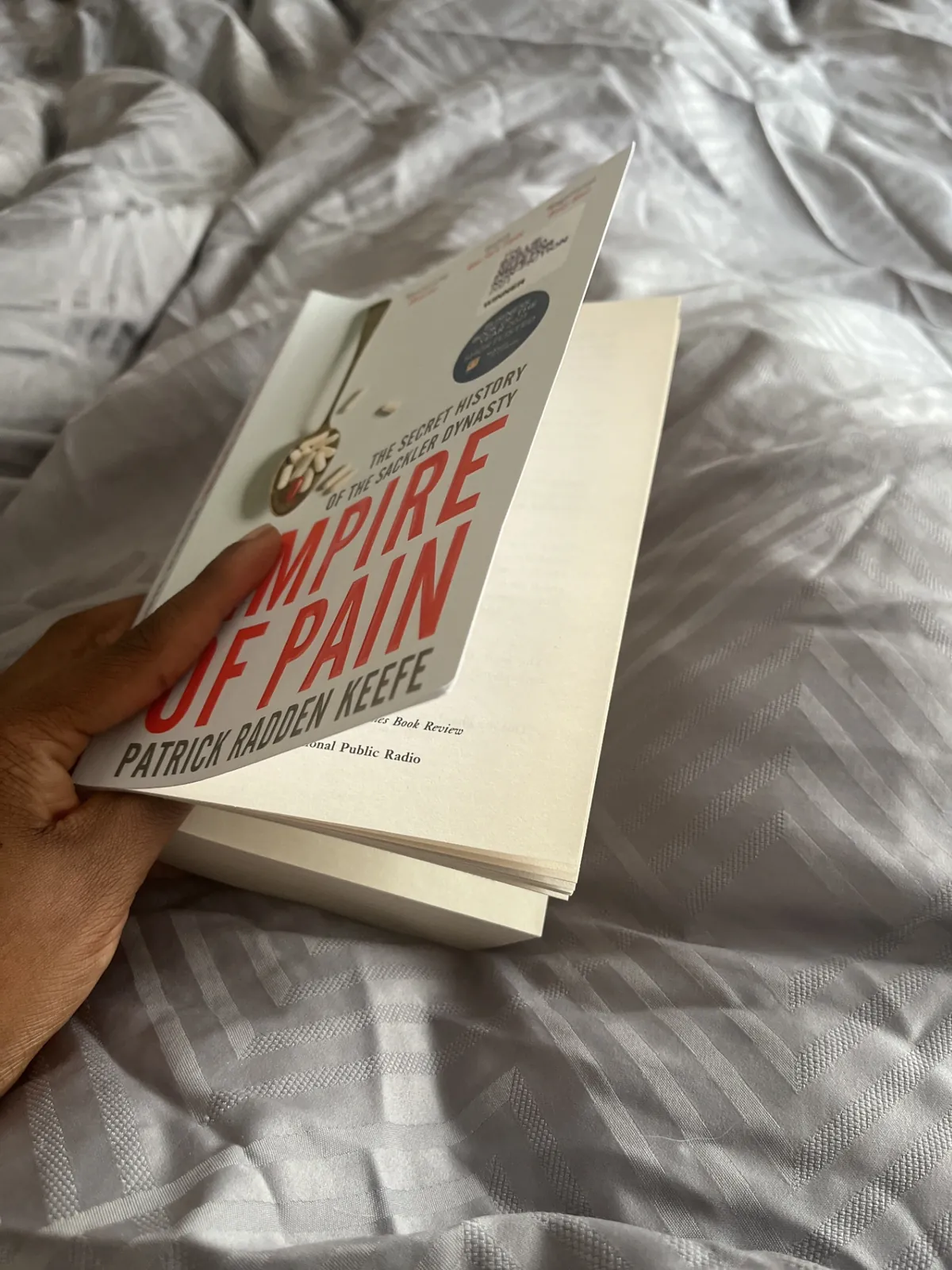
Empire of Pain
by Patrick Radden Keefe
Dear Patrick Radden Keefe,
Thank you for writing the kind of book that answers curiosity with evidence rather than vibe.
My interest in the Sacklers did not begin in a courtroom or a headline. It began in the V&A in London, which is the way many people meet power now: quietly, respectably, through a name on a wall attached to beauty. I used to spend time there, often doing the thing I always do around institutions and wealthy patrons. I would ask, privately, how they made their money. This was not in a nosey or vindictive way. Curiosity in my case is usually aspirational. I want to understand the mechanism; I want to learn the pattern.
That curiosity eventually became personal. I discovered that a branch of the family lived a stone’s throw from me in London. The idea of meeting someone whose name I had seen in a museum felt like meeting a living footnote of modern capitalism. I was eager and ready with questions.
Then the scandal broke. The atmosphere changed instantly. Curiosity became radioactive, doors closed, and conversations became careful. News articles appeared in volume, yet most of them felt like they were written at altitude. There was plenty of outrage but very little anatomy. I found very little that could satisfy the kind of curiosity that is not looking for a villain, but for a map of how this can happen.
Empire of Pain gave me that map.
Thank you for the method. The reporting is exhaustive, yet the writing never collapses into a pile of facts. You showed how the blueprint was drawn by Arthur Sackler—marketing Valium like a distinct new element rather than a sedative—and then weaponised by Richard with OxyContin. The result is rare. The reader does not merely feel anger; the reader understands the machinery that made the anger inevitable.
The most instructive part is that the harm is not presented as a mysterious tragedy. It is presented as a chain. You did not just say "greed"; you showed the specific inventions, such as the concept of "pseudo-addiction" to explain away withdrawal, the co-opting of FDA labelling, and the "blizzard of prescriptions" Richard demanded. The book demonstrates how responsibility can be diluted without being absent. It shows how reputations can be laundered through culture, how institutions can become complicit through politeness and funding dependence, and how moral disgust can arrive late once money has already done its quiet work.
This story also landed on me in a more intimate way. I watched a neighbour slide into an addiction to pain medication. The decline was not cinematic; it was domestic. It had the slow, ordinary shape of dependence: one more prescription, one more justification, one more day of functioning followed by one more day of not functioning. Reading your book, I realised my neighbour was living out a marketing plan drafted in a boardroom thirty years ago. That experience made the book feel less like a scandal and more like a live wire. It is a reminder that corporate strategies are not abstract. They end up in kitchens, bedrooms, and bathrooms.
I am no saint, and my world is not morally pure. I have always struggled to reconcile how people who sell hard drugs live with themselves, whether they operate on a corner or behind a desk. Your book does not preach an answer. It does something more useful. It shows how the story people tell themselves changes depending on how far they can stand from the suffering. Distance becomes a form of conscience management. Plausible deniability becomes a lifestyle.
Thank you for writing with restraint. The moral force is there, yet it is disciplined. The book does not need to shout. It lets the record do the damage. That control makes the indictment feel more credible and more devastating.
Thank you for producing something that is not just information, but equipment. This book sharpens the reader’s ability to see power clearly, to recognise reputation as strategy, and to understand how harm can be manufactured without a single person feeling, in the moment, like the villain.
With respect,
Tendai