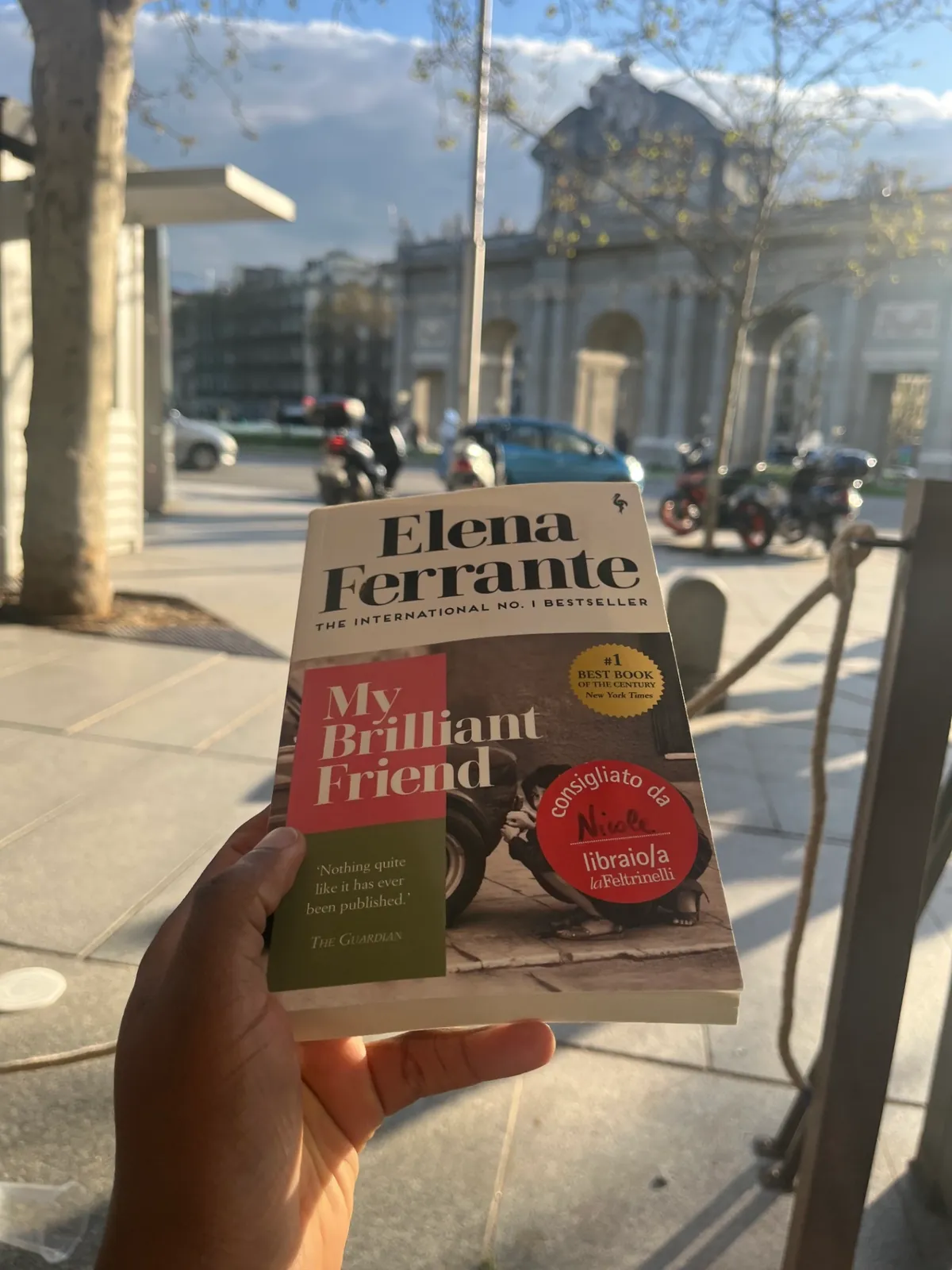
My Brilliant Friend
by Elena Ferrante
Dear Elena Ferrante,
Thank you for refusing to be nice.
Thank you for not giving the reader the sedative version of life, the version where pain arrives with meaning attached, where injustice arrives with a lesson, where women arrive pre-sanitised into virtue. Thank you for writing as if the highest form of respect you can show a reader is to tell the truth cleanly, then walk away.
The first thing I want to thank you for is the tone you set from the beginning, the moral temperature. You make it clear, immediately, that memory will not be turned into a cosmetic product. When you write:
“I feel no nostalgia for our childhood: it was full of violence.”
You are not just describing a childhood. You are declaring a method. You are saying: I will not romanticise what harmed me. I will not turn the past into a warm aesthetic.
That is rare. That is courage that does not announce itself as courage.
Thank you, too, for the discipline of your prose. People often call it “simple,” which I take as a misunderstanding. Your sentences are not simple. They are controlled. They behave like clean glass: you forget the glass is there, then realise you have been staring at something you normally avoid looking at, the copper pots flying across a kitchen, the dust of the courtyard, the bruised skin that everyone pretends not to see.
You keep the self out of the way so reality can dominate. Thank you for that restraint.
Thank you for refusing the two fashionable lies that dominate contemporary writing about women: suffering as spectacle and suffering as empowerment theatre. You leave women complicated: strategic, loving, petty, brilliant, cruel. You describe the terror of smarginatura, the sensation of dissolving margins, of losing one’s outline. You refuse to tidy that chaos for the sake of the reader’s comfort.
You also refuse to let men be simple villains. You show that masculinity is often not just individual cruelty, but a system of enforcement. You show how power reproduces itself not only through fists, but through the Solaras’ money, through debt, gossip, and the silent compliance of those who need the system to function.
Thank you for understanding that the street is not a backdrop. It is an operating system.
In your Naples, the self is never fully private. Family is gravity. Shame is governance. Language is class. Thank you for showing how dialect functions as a trap and Italian as a shield, how a sentence can be a passport or a prison. You show how education enters the bloodstream, how it shapes what a person can safely desire, how it edits their imagination, how it teaches them to feel ashamed of the voices of their own mothers.
Thank you for writing this without lecturing. You show sequences: pressure → adaptation → consequence. The reader learns because they cannot unsee it.
Thank you, most of all, for writing friendship the way it actually functions.
So much literature treats friendship as refuge. You write friendship as voltage: love and rivalry in the same current. Admiration that contains hunger. You show how a friend can be a mirror, a threat, a proof, and a wound, sometimes in the same day.
I must admit, this part stung. I hated how often I recognised myself in Elena Greco: the hunger dressed up as admiration, the loyalty mixed with measurement, the secret relief when a brilliant friend stumbles.
That is not a theme. It is a truth most people live, and most people avoid naming. Thank you for naming it without sentimentality.
As a writer, I also want to thank you for something more structural: your work is proof that a novel can be both addictive and serious. You refused the trade-off between psychological realism and narrative propulsion. You made the social world intelligible without flattening it into ideology. You made interior life vivid without turning it into therapy.
Finally, thank you for the implicit lesson about agency.
Your books show that agency is not simply believing in yourself. Agency is what remains when the world is trying to write you: the capacity to notice the forces acting on you, to name them without romanticising them, and to choose what you will and will not become in response, even when the choices have penalties.
That is what I walked away with: not an Italian story, not a female friendship novel, but a clearer understanding of how a life is manufactured, and how rare it is to see that process rendered without lies.
Thank you for the truth.
Thank you for the clean glass.
With respect,
Tendai