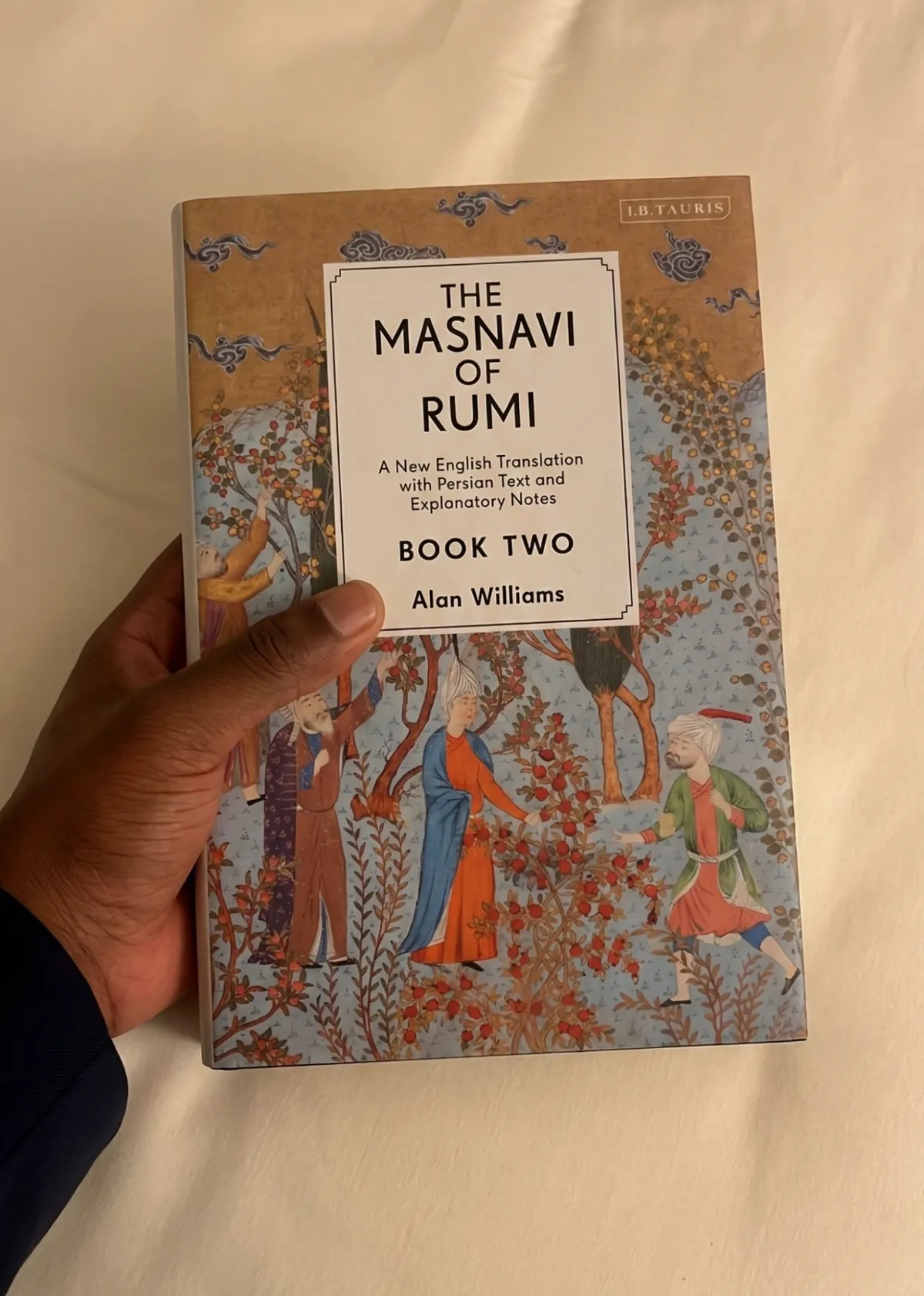
On Reading Rumi’s Masnavi
by Tendai Shamu
A guide to reading the Masnavi that strips away the "New Age" myths to reveal Rumi’s rigorous philosophy of separation and ego annihilation. This piece offers specific tactical advice for the modern reader, recommending the Mojaddedi translation and outlining a method for navigating the text's rhizomatic structure.
1. The Deception
For years I avoided Rumi. The Rumi of the western imagination—the best-selling poet in America, the darling of spiritual Instagram—seemed to be a purveyor of vague, therapeutic aphorisms. We have all seen the quotes. "Out beyond ideas of wrongdoing and rightdoing, there is a field. I’ll meet you there." It sounds pleasant, secular and distinctly modern, offering a safe space for conflict resolution where no one has to feel bad about anything.
It turns out this is a deception. I started reading the Masnavi-ye Ma'navi (The Spiritual Couplets) a few months ago, and the author I encountered bears almost no resemblance to the gentle sage of the greeting cards. The real Rumi is a rigorous Hanafi jurist, a terrifying intellectual and a man in the grip of a catastrophic spiritual crisis. His magnum opus is not a collection of comforting poems. It is a twenty-five thousand verse monster that weaves Quranic exegesis, dirty jokes, folklore and high metaphysics into a structure that feels less like a book and more like a spiraling DNA helix of consciousness.
Undertaking the Masnavi is an act of deprogramming. One must unlearn the hallmark version to encounter the reality, which is that Rumi is not trying to make you feel better. He is trying to annihilate your ego.
2. The Structure
The experience of reading the Masnavi is initially disorienting. If you approach it expecting the linear narrative structures of the West—beginning, middle, end—you will be driven mad.
Scholars describe the structure as 'rhizomatic'. Rumi will begin a story about a king and a handmaiden. In the middle of a sentence, a single word will trigger an association and he will pivot immediately into a story about a greengrocer and a parrot. This parrot might remind him of a theological point about free will, which leads to a bawdy joke about a woman and a donkey, before returning to the king four hundred lines later.
This disjointedness is a feature rather than a bug. It is an instructional curriculum designed to induce a trance state. Rumi attempts to break the reader’s reliance on linear, logical causality—the way of the intellect—to force a shift into associative, intuitive leaps. It reminds me of the way memory works in Proust, where a single sensory trigger pulls the entire past into the present, or perhaps the structure of jazz improvisation. You must accept a suspension of orientation. You must be willing to be lost.
3. The Reed Flute
The philosophy of the book is contained entirely in the opening eighteen lines, known as the Ney-nameh or 'Song of the Reed'. It begins not with a greeting, but with a cry of pain.
Listen to this reed as it is grieving It tells the story of our separation
The core mechanism of Rumi’s thought is not love, as is commonly supposed, but separation (firāq). The central metaphor is the Ney, a traditional Persian reed flute. To make such a flute, one must cut a reed from the riverbed—the initial trauma of separation from the source. One must then dry it out and burn holes in it using a hot iron. This is the discipline of suffering. Only when the reed is hollow, empty of its own substance, can the breath of the player flow through it to make music.
We are the reed. The music is our longing to return to the reed-bed.
This presents a reversal of modern psychology. Modernity suggests we should heal our trauma to be happy and whole. Rumi argues we must cherish the wound, for the hollowness is the only place the breath of the divine can enter. If you are full of yourself—your ego, your status, your desire to be in the 'inner ring'—you are merely a solid stick. You make no music. The goal is Fana, or annihilation of the self.
4. The Scandal
You cannot understand the text without understanding the scandal that birthed it. Rumi was once a respectable, orthodox professor of religion with status, students and wealth. He was firmly inside the establishment.
Then he met Shams Tabrizi, a wandering, anti-social dervish who looked like a beggar. Shams challenged Rumi, debated him and eventually Rumi abandoned his podium to stare into the eyes of this wild mystic for months on end.
Rumi’s society was horrified. They drove Shams away—and likely murdered him—leaving Rumi in a state of devastation. The Masnavi was written in the wake of this loss. It is a book written by a man who had everything, lost it, and found something more than truth in the wreckage.
This mirrors the intense Girardian themes found in Proust. Rumi had to abandon the mimetic desires of the status-seeking scholars of Konya to find the vertical desire of the divine. He realised that the inner ring of respectable society was hollow, and that the only way out was through the social death of loving a madman.
5. Tactics
A brief aside on tactics. The Masnavi is difficult and long, so here is how one should approach it.
First, the translation. This is critical. You must stop reading Coleman Barks. This is a controversial stance, as Barks is responsible for Rumi’s western fame, but he does not speak Persian. He takes literal Victorian translations and remixes them into free verse, stripping out the Islamic context to make it palatable for a secular western audience. If you want the uncommon taste, you need a translation that respects the complexity and the rhyme scheme.
I recommend Jawid Mojaddedi’s translations for the Oxford World’s Classics. Mojaddedi is the first person to translate the entire Masnavi into English rhyming couplets. Rumi is music; the text is meant to be recited, not silently read. Mojaddedi preserves the rhythm—AABB rhyme scheme—and, crucially, keeps the footnotes. One cannot understand Rumi without understanding the Quranic verses and Hadiths he constantly references.
Second, how to read it. Do not binge. Read one teaching story at a time. I found reading aloud to be helpful. The rhyme scheme in Mojaddedi’s translation is hypnotic, and when spoken, it becomes an incantation rather than a text.
Third, accept the low humour. You will encounter stories about sexual deviance and crude bodily functions. Do not look away. Rumi uses the profane to illustrate that the divine is hidden in the lowest matter. He is breaking your puritanical pride.
6. The Organ of Perception
We live in a time of extreme literalism. We are obsessed with data and optimising our lives. Rumi serves as an antidote to the optimised life. He argues that the intellect is a useful donkey that can carry you to the door, but it cannot take you inside the house. Inside the house, you need a different organ of perception: the Heart (Qalb).
In this context, the heart is not a metaphor for emotion. It is a sensory organ capable of perceiving realities that the intellect cannot. Reading Rumi is an exercise in developing that organ. It is a training in seeing the Form (Surat) versus the Meaning (Ma'ni). The world we see is merely the foam on the ocean; Rumi teaches you to dive beneath the foam.
You are not a drop in the ocean. You are the entire ocean, in a drop.
To realise that, however, you have to break the container. That is what this book does. It breaks you.
7. Further Reading
The Masnavi: Book One, translated by Jawid Mojaddedi.
Rumi’s Secret by Brad Gooch. A fantastic historical biography that strips away the myth.
Rumi: Past and Present, East and West by Franklin D. Lewis. The scholarly gold standard.